


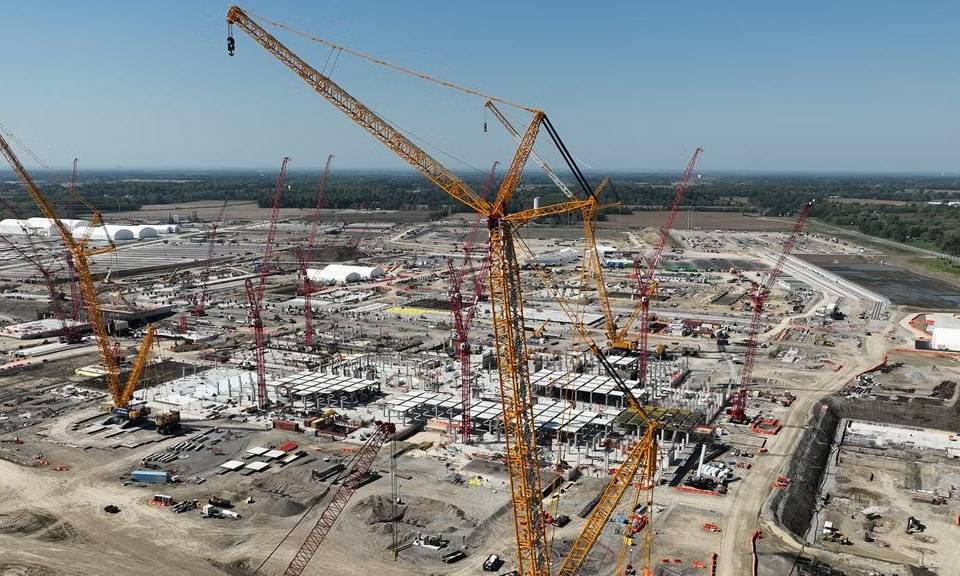
Intel Advances Ohio Chip Factory Construction as Production Target Remains Five Years Away
Intel has installed the first major structural truss at its Ohio semiconductor manufacturing campus, marking a new construction milestone as the company works toward expanding its US chipmaking capacity. However, the first factory is not expected to begin operations until 2030 or 2031, five to six years later than originally planned.
The milestone, announced on October 21, comes as Intel seeks to expand its US manufacturing capacity and attract external customers for its foundry business. The company is also advancing construction at its Arizona facilities and reassessing the pace of its wider manufacturing expansion.
“We continue to evaluate unique and highly differentiated opportunity to accelerate our Ohio build-out.” – Intel CEO Lip-Bu Tan
The first structural truss was installed at Intel’s Ohio One campus in New Albany, northeast of Columbus. The project involves two planned semiconductor fabrication plants, known as fabs, which will manufacture advanced chips. Intel Foundry chief technology and operations officer Naga Chandrasekaran described the installation as a significant step toward expanding US semiconductor production in an October 21 company update.
Intel Revises Ohio Manufacturing Timeline
Intel originally announced its Ohio investment in January 2022, with plans to begin production in 2025. The company subsequently revised its construction schedule as it reassessed capital spending and demand for its manufacturing services.
Under the revised timeline announced in February 2025, construction of the first facility, Mod 1, is expected to finish in 2030, with operations targeted for 2030 or 2031. The second facility, Mod 2, is scheduled for completion in 2031. Intel outlined the changes in its Ohio One construction timeline update.
The revised schedule reflects Intel’s intention to align manufacturing investments with customer demand and manage capital expenditure more carefully. The company has retained the flexibility to accelerate construction if demand warrants additional capacity.
The Ohio campus forms part of Intel’s broader strategy to establish a contract chip manufacturing business capable of competing with Taiwan Semiconductor Manufacturing Company (TSMC). However, securing external customers remains a significant challenge as the company attempts to rebuild confidence in its manufacturing technology.
SK hynix Talks Could Expand Ohio’s Role in Semiconductor Production
Potential cooperation with South Korean memory manufacturer SK hynix could provide another opportunity for Intel to utilise its Ohio facilities.
In September, Reuters reported that the companies were discussing arrangements that could allow SK hynix to manufacture memory chips in the United States for the first time. One possibility involved leasing space at Intel’s planned Ohio facility, while another involved establishing a joint venture with Intel and major cloud computing companies seeking more secure memory supplies.
The discussions come amid strong demand for high-bandwidth memory (HBM), a critical component in artificial intelligence infrastructure. HBM is used alongside advanced processors in AI accelerators and data centre systems.
However, neither company has announced a confirmed agreement. The discussions remain exploratory, meaning the potential partnership cannot yet be considered a source of committed demand for the Ohio campus.
A partnership could potentially help Intel utilise its manufacturing infrastructure while providing SK hynix with additional production capacity in the US. Nevertheless, any arrangement would depend on commercial negotiations and the technical requirements of memory manufacturing.
Intel Expands Arizona Production as Foundry Strategy Develops
While construction continues in Ohio, Intel is making progress at its existing manufacturing sites in Arizona.
On October 21, the company confirmed that construction and equipment installation were underway at Fab 62, its next high-volume manufacturing facility at the Ocotillo campus. Intel expects operations to begin by the end of 2028, according to its latest manufacturing update.
Intel has also been ramping up production using its Intel 18A process technology, which entered high-volume manufacturing in 2025. The process incorporates RibbonFET gate-all-around transistors and PowerVia backside power delivery, technologies designed to improve chip performance and power efficiency.
The company is seeking to attract external customers for its manufacturing processes, rather than relying exclusively on its own processor designs to support factory utilisation. Its ability to secure these contracts will be important in determining whether its substantial manufacturing investments can generate sustainable returns.
Foundry Investment Faces Commercial Challenges
Intel’s latest financial results offer a mixed picture of its recovery. The company reported third-quarter 2026 revenue of $16.5 billion, representing a 21% increase year over year, according to its October 29 financial results.
Its Data Center and AI business generated $7.3 billion in revenue, up 78% from the corresponding period in 2025, reflecting demand for server processors and computing infrastructure.
Intel Foundry reported segment revenue of $6.7 billion, although this figure includes transactions with Intel’s other business units. External foundry revenue was $411 million, highlighting the continuing gap between the company’s manufacturing ambitions and its commercial relationships with outside customers. The distinction is detailed in Intel’s third-quarter SEC filing.
The foundry segment also recorded an operating loss of approximately $1.85 billion during the quarter, underlining the financial challenge of building and maintaining advanced manufacturing capacity.
Intel’s ability to secure external manufacturing contracts will therefore be central to the long-term viability of its expansion strategy. Although demand for AI computing and advanced semiconductors is creating opportunities for additional production capacity, the company must demonstrate that its manufacturing technology can meet customer requirements on performance, yield and cost.
The Ohio construction milestone signals continued progress on Intel’s US manufacturing ambitions. However, turning the project into a commercially successful operation will depend on more than completing the buildings: the company will need to secure customers willing to commit to production capacity years before the factories become operational.
Headline photo: A picture of Intel’s chip factory construction site in Ohio (Photo: Image courtesy of Intel via its official Ohio press release)
Leave a Reply